
Dimitrina Sevova, August Diary: Lovers, 2025
31 drawings (30 + 1)
30 monochromatic drawings: Lovers, 2025. Unprocessed graphite, graphite, charcoal, 300 g Arche Aquarelle paper, approx. 56 cm × 76 cm
31st drawing: Forest at dusk (Investigation of Urpflanze), 2023. Pigment and charcoal on 350 g Dorée paper, approx. 145 cm × 124 cm
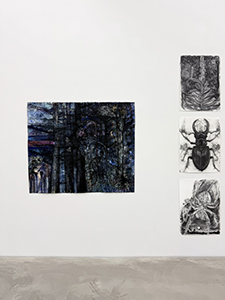
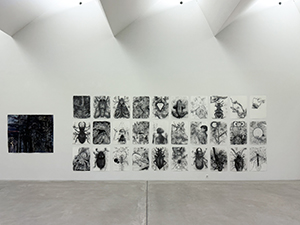
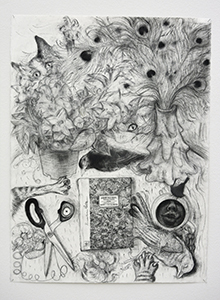
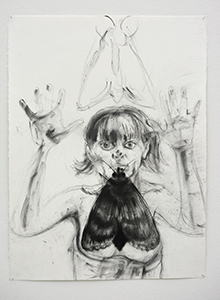
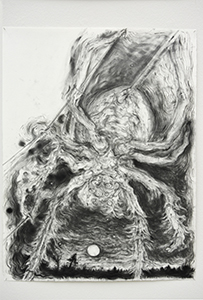
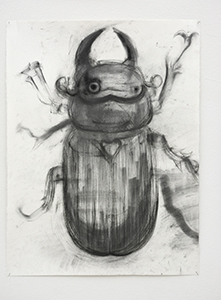
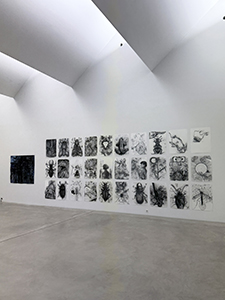
Dimitrina Sevova, August Diary: Lovers, 2025
Text on Dimitrina Sevova’s work in the Werkschau 2025 brochure
When I visit Dimitrina Sevova in her studio, she has just returned from an artist residency at the Lilly Keller Foundation in Thusis. Her stay in Graubünden has left a lasting impression. She enthusiastically tells me about her studio close to nature, her encounters with insects and plants, and the natural graphite she found near the riverbed of the Nolla, which she used to draw with during her stay. “Graphite is a fascinating mineral,” explains the artist. “It is a modification of coal and is created in a process of transformation between organic and inorganic materials – in this sense, it is connected to the cycle of life. In contrast, processed graphite, which is used in a wide variety of areas in carbon capitalism, such as computers and nuclear power plants, is produced from fossil fuels in industrial high-temperature processes that are energy-intensive and harmful to the environment. I am fascinated by drawing with a material that has so many connections.” Dimitrina Sevova used natural graphite for the first time in this series. However, she has been interested in clay, earth, minerals, pigments, and stones for quite some time: most recently, the artist often worked with ceramics or painted pictures using various types of earth as a painting medium.
In the exhibition for the Werkschau, Dimitrina Sevova displays 30 drawings that she created using the natural graphite she collected. The series “August Diary: Lovers,” 2025, is based on observations and encounters with nature during her stay in Thusis. Insects and plants appear to us in ways that are sometimes eerie, sometimes psychedelic. The series is accompanied by a larger colored drawing that portrays the forest at night. The drawings reveal how they were made with the material. The hardness of the different graphite stones has an effect on the painted result: sometimes the lines are lighter, sometimes darker, sometimes Sevova grinds the crumbling powder or uses the sharp edges of the stone to create hard lines.
Text zu Dimitrina Sevovas Arbeit in der Werkschau 2025 Broschüre
Als ich Dimitrina Sevova in ihrem Atelier besuche, ist sie gerade zurückgekommen aus einer Artist Residency in der Lilly Keller Stiftung in Thusis. Der Aufenthalt in Graubünden hat nachhaltige Spuren hinterlassen. Voller Begeisterung erzählt sie mir von dem naturnahen Atelier, den Begegnungen mit Insekten und Pflanzen und dem Naturgraphit, den sie nahe dem Flussbett der Nolla fand und mit dem sie während ihres Aufenthalts gezeichnet hat. «Graphit ist ein faszinierendes Mineral», führt die Künstlerin aus. «Er ist eine Modifikation von Kohle und entsteht in einem Prozess von Umwandlungen zwischen organischen und anorganischen Materien – darin ist er mit dem Lebenszyklus verbunden. Dagegen wird der verarbeitete Graphit, der im Kohlenstoffkapitalismus in unterschiedlichsten Bereichen zum Einsatz kommt, etwa in Computern oder Atomkraftwerken, in industriellen Hochtemperaturprozessen energieaufwändig und umweltschädlich aus fossilem Brennstoff hergestellt. Mich fasziniert, mit einem Material, das so viele Verbindungen in sich trägt, zu zeichnen». Mit Naturgraphit hat Dimitrina Sevova in dieser Serie zum ersten Mal gezeichnet. Ihr Interesse an Ton, Erde, Mineralien, Pigmenten und Steinen besteht aber schon länger: zuletzt arbeitete die Künstlerin oft mit Keramik oder malte Bilder, für die sie als Malsubstanz verschiedene Erden benutzte.
In der Ausstellung für die Werkschau zeigt Dimitrina Sevova 30 Zeichnungen, die sie mit dem gesammelten Naturgraphit gezeichnet hat. Die Serie «August Diary: Lovers», 2025, basiert auf Beobachtungen und Begegnungen mit der Natur während ihres Aufenthalts in Thusis. Insekten und Pflanzen begegnen uns in mal unheimlich, mal psychedelisch anmutender Art und Weise. Begleitet wird die Serie von einer grösseren farbigen Zeichnung, die den Wald bei Nacht porträtiert. Den Zeichnungen sieht man ihre Fertigung mit dem Material an . So hat der Härtegrad der unterschiedlichen Graphitsteine eine Auswirkung auf das gemalte Resultat: Mal sind die Linien heller, mal dunkler, mal zerreibt Sevova das bröckelnde Pulver oder benutzt die scharfen Kanten des Steins, um harte Linien zu erzeugen.
Artist’s text on her work at the Werkschau 2025
My work for the Canton of Zurich’s 2025 exhibition is a series of 30 monochromatic graphite drawings and one charcoal-pigment drawing, Forest at dusk (Investigation of Urpflanze), under the title August Diary: Lovers. Some are detailed and reminiscent of scientific studies, while others are gestural and expressive. They explore the relationship between figurative representation and the thread of abstraction that runs through all shades of life. They are based on observations and encounters with nature and refer to the alchemical metaphor of transformation as well as to symbioses between plants and insects and other small creatures that live in the ever-changing summer garden and even in the studio. I adopt Lilly Keller’s view of the garden as a small world in which the boundaries between art and life/nature dissolve, where the metamorphosis of living ephemera and elemental transformations reveal their interweaving.
The drawings were created primarily using raw natural graphite that I found in a small open deposit near the riverbed of the Nolla. I applied this raw material directly to 300-gram handmade cotton paper, which which enables bold, visually striking markings. The images were drawn using small graphite sticks in various shades of gray and degrees of hardness, as well as soft, dark flakes, creating sharp lines reminiscent of etchings and powdery textures that are rubbed onto the surface by hand. The drawings reflect my fascination with the crystalline structure of graphite: soft, opaque, and black, yet chemically identical to the extremely hard, transparent, and shiny diamond.
Graphite is of central importance to the series, both for its material qualities and as a metaphor. Carbon, the element found in graphite, is a building block of life that exists in a constant exchange between living organisms and inorganic forms. It also occurs as cosmic dust. In the series, I engage with the act of drawing itself – a form of seeing and not seeing, of learning and unlearning at the same time. The image itself is shaped not only by artistic intent but also by nature, by fossilization, in which a carbonized film – a 2D imprint – typically preserves delicate details, even cells from plants, insects, fish, and other small animals. By using graphite, I establish a connection to the origin of drawing from the Greek word graphein, meaning “to write.” A graphic is also a record of data. Carbon particles play a crucial role in the storage of data in DNA and are used in industry as the perfect medium.
As a diary, these drawings are not merely a snapshot of the moment, but a way for me, as an artist, to construct memories. They are not just entries collected day by day; they also weave a non-narrative story.
Text der Künstlerin über ihre Arbeit an der Werkschau 2025
Meine Arbeit für die Werkschau 2025 des Kantons Zürich ist eine Serie von 30 monochromatischen Graphit-Zeichnungen und eine Kohle-Pigment-Zeichnung, Forest at dusk (Investigation of Urpflanze), unter dem Titel August Diary: Lovers. Einige sind detailliert und erinnern an wissenschaftliche Studien, während andere gestisch und expressiv sind. Sie erkunden das Verhältnis zwischen figurativer Darstellung und dem Faden der Abstraktion, der sich durch alle Schattierungen des Lebens zieht. Sie basieren auf Beobachtungen und Begegnungen mit der Natur und beziehen sich auf die alchemistische Metapher der Verwandlung sowie auf Symbiosen zwischen Pflanzen und Insekten und anderen kleinen Lebewesen, die in dem sich ständig verändernden Sommergarten und sogar im Atelier leben. Ich übernehme Lilly Kellers Sicht des Gartens als eine kleine Welt, in der sich die Grenzen zwischen Kunst und Leben/Natur auflösen, in der die Metamorphose lebender Ephemera und elementare Transformationen ihre Verwobenheit offenbaren.
Die Zeichnungen wurden hauptsächlich mit unbearbeitetem Naturgraphit angefertigt, den ich in einer kleinen offenen Lagerstätte beim Flussbett der Nolla fand. Ich trug dieses Rohmaterial direkt auf 300 g schweres handgeschöpftes Baumwollpapier auf, was kraftvolle, physisch wirkende Markierungen ermöglicht. Die Bilder wurden mit kleinen Graphitsteinen in verschiedenen Graustufen und Härtegraden sowie mit weichen, dunklen Flocken gezeichnet, wodurch scharfe, an Radierungen erinnernde Linien und pudrige Texturen entstehen, die von Hand auf die Oberfläche gerieben werden. Die Zeichnungen spiegeln meine Faszination für die kristalline Struktur von Graphit wider: weich, undurchsichtig und schwarz, aber chemisch identisch mit dem extrem harten, transparenten und glänzenden Diamanten.
Graphit ist sowohl aufgrund seiner materiellen Qualität als auch als Metapher von zentraler Bedeutung für die Serie. Kohlenstoff, das Element in Graphit, ist ein Baustein des Lebens, der in einem ständigen Austausch zwischen lebenden Organismen und anorganischen Formen steht. Er kommt auch als kosmischer Staub vor. In der Serie beschäftige ich mich mit der zeichnerischen Tätigkeit selbst, eine Form des Sehens und Nicht-Sehens, des Lernens und Verlernens zugleich. Das Bild an sich wird nicht nur durch die künstlerische Absicht geformt, sondern auch in der Natur, in der Fossilisierung, bei der typischerweise ein verkohlter Film, ein 2D-Abdruck filigrane Details bewahrt, sogar Zellen von Pflanzen, Insekten, Fischen und anderen kleinen Tieren. Durch die Verwendung von Graphit stelle ich eine Verbindung zur Herkunft des Zeichnens von graphein, schreiben her. Eine Grafik ist auch eine Aufzeichnung von Daten. Kohlenstoffpartikel spielen eine entscheidende Rolle bei der Speicherung von Daten in der DNA und werden in der Industrie als perfektes Medium eingesetzt.
Als Tagebuch bilden die Zeichnungen nicht nur ein Eindruck des Moments, sondern eine Form der Erinnerungsbildung für mich als Künstlerin. Es sind nicht nur Tag für Tag zusammengetragenen Einträge, sondern sie weben auch eine nicht-narrative Geschichte.
Group exhibition, Werkschau 2025, Canton of Zurich
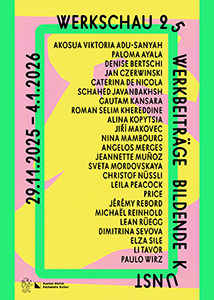
Group exhibition, Werkschau 2025, Canton of Zurich. Flyer
28 November 2025 - 04 January 2026
Kunstmuseum Winterthur, Museumstrasse 52, 8400 Winterthur
Opening: Friday, 28 November 2025, 17:30h - 20:30h